
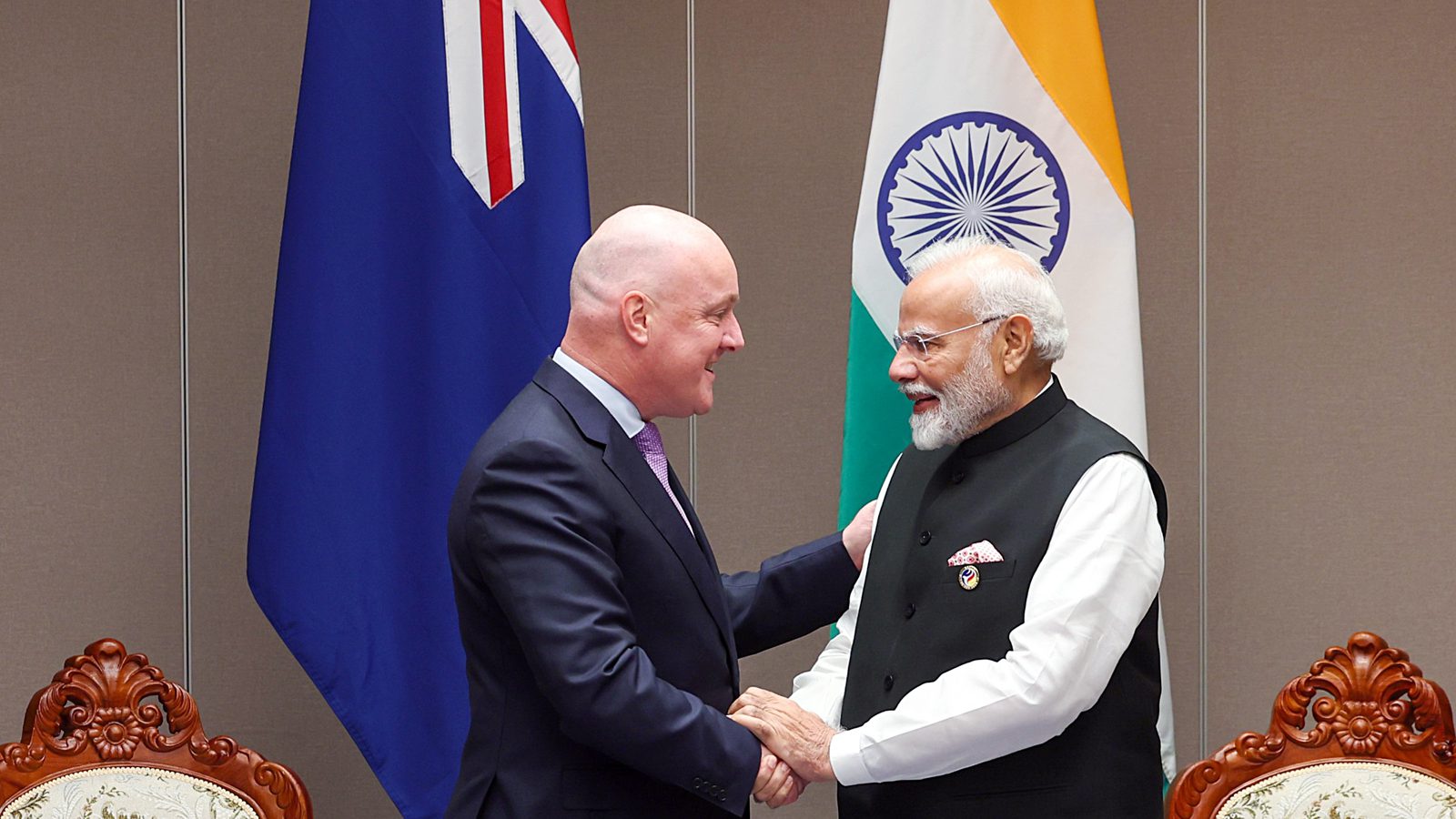
In December 2025, India and New Zealand concluded negotiations on a comprehensive trade pact. The India New Zealand Free Trade Agreement marks a significant step in India’s global trade diplomacy and signals deeper economic alignment between two like-minded democracies.
Although the agreement awaits formal signing and ratification, it is already being viewed as one of India’s most forward-looking trade deals in the Oceania region.
Expanding Trade Horizons
At the core of the agreement lies an ambition to significantly expand bilateral trade over the coming decade. Under the concluded terms, New Zealand will provide zero-duty market access to 100 percent of Indian exports.
Key beneficiary sectors include textiles, leather goods, engineering products, pharmaceuticals, gems and jewellery, and marine exports. The agreement is expected to enhance competitiveness for Indian manufacturers and MSMEs.
India, in return, has agreed to reduce or eliminate tariffs on a substantial share of New Zealand’s exports. Roughly 70 percent of tariff lines and about 95 percent of trade value are covered, with sensitive sectors such as dairy protected through phased reductions and safeguard mechanisms.
Services, Skills and Mobility
Unlike many traditional trade agreements, the India New Zealand Free Trade Agreement places strong emphasis on services and people-to-people mobility. Provisions aim to facilitate the movement of skilled professionals across sectors including IT, healthcare, engineering, and education.
Indian students stand to benefit from improved post-study work opportunities, while young professionals may gain access to expanded working-holiday visa routes. These measures reflect a growing recognition that modern trade extends beyond goods into talent and knowledge exchange.
Investment and Long-Term Cooperation
Investment forms another key pillar of the agreement. New Zealand has indicated a long-term commitment to investing in India across infrastructure, renewable energy, education, and agri-technology.
For India, this aligns with national priorities such as manufacturing expansion, green growth, and skill development. Beyond economics, the agreement strengthens strategic trust and cooperation in areas like innovation, supply-chain resilience, and sustainable development.
Strategic Significance in a Shifting Global Order
The agreement comes at a time of global trade uncertainty marked by protectionism and shifting alliances. Against this backdrop, the pact signals India’s willingness to pursue balanced, mutually beneficial trade frameworks that protect domestic interests while embracing global integration.
Once implemented, the agreement is expected to reshape India’s engagement with the Oceania region. For New Zealand, it offers deeper access to one of the world’s fastest-growing major economies.
What Lies Ahead in 2026
As both countries prepare for the next steps in 2026, the India New Zealand Free Trade Agreement stands as more than a tariff-cutting exercise. It reflects shared values, long-term vision, and a strategic commitment to cooperation beyond economics.
In an evolving global trade environment, the pact underscores how partnerships rooted in trust and foresight can shape sustainable growth
A truly premium feeling platform. Everything from the layout to the bonuses screams luxury and quality. Head over to luxebet77login
I have been playing here for a few weeks now and the payouts are surprisingly fast. Definitely one of the smoothest experiences I have had lately. Check out br567br for a great time.
The variety of games available here is insane. I spent the whole night exploring different slots and won a decent amount. Give plataforma78955 a try if you love variety.