
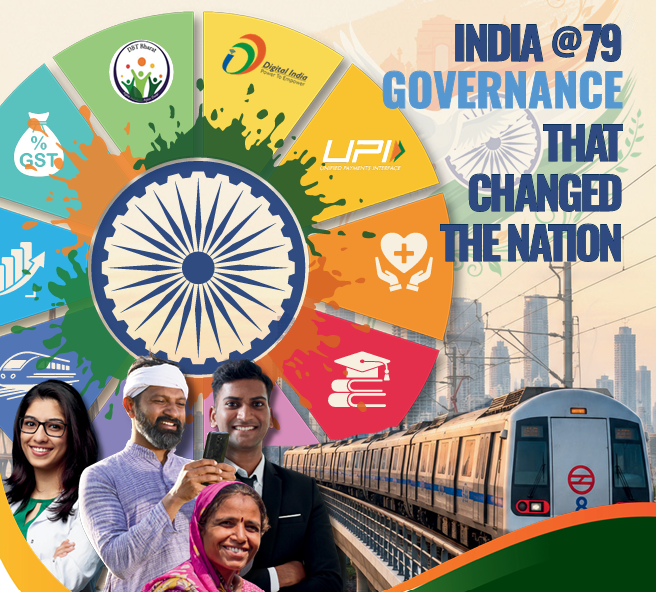
As India marks its 79th year of Independence, the conversation has shifted from celebrating milestones to evaluating transformation. Over the past three decades, the country has introduced reforms that have reshaped governance, public service delivery, infrastructure, and citizen engagement. Together, these initiatives tell a larger story of how institutions have evolved to become more responsive, technology-driven, and citizen-centric.
The journey has not been defined by a single programme. Instead, it reflects a series of reforms that gradually removed barriers, improved transparency, and expanded opportunities. From economic liberalisation to Digital India and Mission Karmayogi, each initiative has contributed to building a governance framework that focuses on results as much as policy.
Reforming Systems for a New India
India’s reform journey has evolved in phases. Initially, reforms focused on opening the economy and reducing barriers to enterprise. Later, the emphasis shifted towards connecting citizens, markets, and institutions through digital and financial infrastructure. Today, reforms increasingly focus on improving service delivery and achieving measurable outcomes.
More importantly, these reforms have moved beyond administrative efficiency. They now aim to improve everyday life by making governance faster, more transparent, and more accessible.
Digital India Changed the Way Citizens Access Government
Technology has become one of the strongest pillars of governance reform. Digital platforms have simplified access to public services while reducing dependence on paperwork and physical offices.
Similarly, digital infrastructure has enabled governments to deliver services at an unprecedented scale. As a result, citizens can now access information, apply for services, and complete transactions more efficiently than before. The Digital India initiative represents a broader shift towards technology-enabled governance.
UPI and DBT Redefined Public Service Delivery
Financial inclusion has also become a key part of India’s governance transformation. The rapid expansion of digital payments through UPI has made transactions faster, easier, and more accessible.
Likewise, Direct Benefit Transfer (DBT) has changed the way welfare reaches beneficiaries. Instead of passing through multiple administrative layers, eligible citizens receive benefits directly into their bank accounts. Consequently, the process has become more transparent while reducing dependence on intermediaries.
However, the significance of DBT extends beyond technology. It reflects a larger governance philosophy where success is measured not only by announcing policies but by ensuring that benefits actually reach citizens.
GST and Gati Shakti Strengthened National Integration
Large-scale reforms have also reshaped India’s economic and infrastructure landscape.
The introduction of the Goods and Services Tax (GST) created a more integrated indirect tax framework. Although implementation required coordination across states and institutions, the reform demonstrated how cooperative policymaking could reduce fragmentation within a federal system.
Meanwhile, PM Gati Shakti adopted a systems-based approach to infrastructure planning. Rather than treating roads, railways, ports, and logistics as separate projects, the initiative emphasises integrated connectivity. Therefore, infrastructure planning increasingly focuses on coordination instead of isolated development.
Development Now Focuses on Outcomes
Another important shift has been the growing emphasis on measurable outcomes. The Aspirational Districts Programme reflects this change by encouraging data-driven governance and targeted development in historically underserved districts.
Instead of asking whether funds were allocated, policymakers now ask whether learning outcomes improved, healthcare became more accessible, and livelihoods strengthened. Consequently, governance has moved from measuring inputs to evaluating real-world impact.
Health, Education and the Bureaucrat of the Future
The magazine notes that India’s next phase of reforms increasingly focuses on people rather than systems alone. Health initiatives, including Ayushman Bharat and the Ayushman Bharat Digital Mission, seek to improve accessibility and strengthen preventive healthcare. At the same time, the National Education Policy 2020 aims to promote multidisciplinary learning, foundational literacy, vocational exposure, and greater use of technology.
The article also highlights Mission Karmayogi as an important step towards preparing civil servants for changing governance needs. Future administrators will require knowledge of technology, data, sustainability, communication, and behavioural change. Nevertheless, the article argues that technology should complement—not replace—human judgement and empathy in public administration.
Governance Is a Continuous Journey
According to the magazine, India’s governance story is ultimately about the willingness to reform rather than any single policy. As new challenges emerge, including artificial intelligence, climate resilience, urbanisation, cybersecurity, and the future of work, the reform agenda must continue to evolve.
The article concludes that governance should be measured by how effectively public institutions convert policy into opportunity, dignity, and a better quality of life. It also reminds readers that behind every reform are countless public servants whose everyday work keeps the nation moving.